



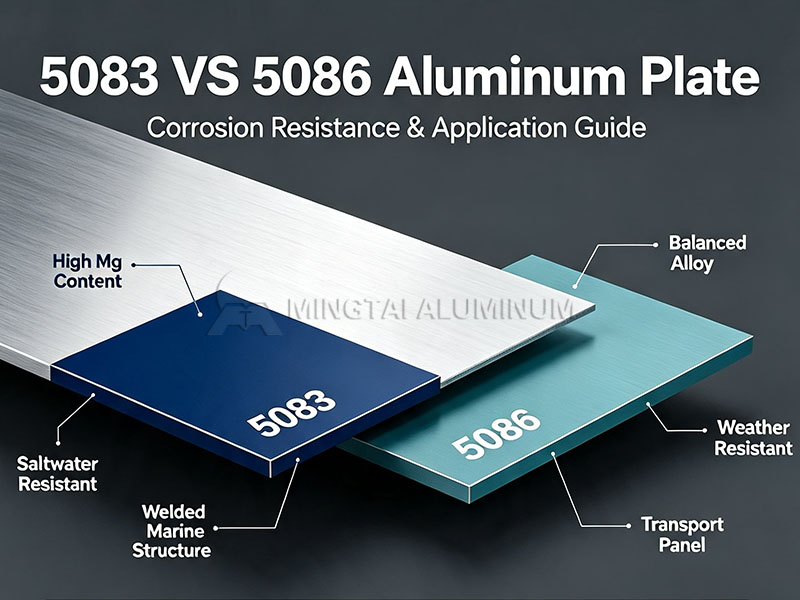
5083 VS 5086 Aluminum Plate – Corrosion Resistance & Application Guide
Sample: A4 Sized
Payment Terms: L/C,D/P,T/T
Delivery time: Within 15-30 Days
Email Us:sale06@mingtai-al.com
Al‑Mg series aluminum plates are the top‑choice material for marine and offshore environments thanks to excellent seawater corrosion resistance and reliable welding performance. 5083 vs 5086 aluminum plate are two frequently‑specified grades, and many engineers struggle to tell them apart. Though they look similar, differences in chemical composition create clear gaps in mechanical properties, anti‑corrosion performance, cost and suitable working scenarios.
Mg Content: The Core Composition Difference
Magnesium is the main alloying element for 5xxx aluminum alloys, directly deciding strength and corrosion performance.
5083 aluminum plate: Mg content 4.0%‑4.9%. Higher magnesium brings higher base strength.
5086 aluminum plate: Mg content 3.5%‑4.5%. Slightly lower magnesium than 5083.
5083 vs 5086 aluminum plate: Corrosion Resistance, Strength & Welding, Cost
Corrosion Resistance
Both deliver outstanding resistance against seawater, marine atmosphere and general industrial corrosion.
5086: Slightly better resistance to stress corrosion cracking. Lower magnesium reduces SCC risk under long‑term marine stress exposure. It performs well in continuous seawater immersion.
5083: Very good corrosion performance, widely proven in marine service. When exposed to sustained high‑stress marine environments, it has marginally higher SCC risk compared with 5086.
Mechanical Strength
Yield strength and tensile strength of 5083 sit above 5086 under the same temper, That means 5083 aluminum plate can bear higher structural loads.
Welding Performance
- Both have excellent weldability. No hot‑cracking tendency with standard marine welding procedures.
- 5083: Higher base strength delivers higher absolute joint strength after welding.
- 5086: Weldability is equally stable; lower magnesium gives slightly better resistance to weld‑related stress corrosion risk.
Cost Difference
Under identical size, temper and surface quality:
5083 aluminum plate is moderately more expensive than 5086 aluminum plate.
Higher magnesium alloying elements push raw‑material costs upward. Price gap is usually not extreme but matters for large‑volume projects.
Application Recommendation for Marine, Offshore Platform & Storage Tanks
Marine industry
5083: Most popular for ship hull structures, decks, superstructures, boat frames. Ideal where higher structural strength is prioritized.
5086: Preferred for vessels working in persistent seawater immersion with long‑term static load. Good for hull plating and auxiliary structures when SCC risk needs extra attention.
Off‑shore platforms
5083: Used for non‑critical secondary structures, walkways, handrails, deck panels.
5086: Better fit for offshore equipment facing continuous seawater splash and static stress. Frequently specified by offshore project standards for corrosion‑critical components.
Storage tanks
Tanks for fresh water, general chemical media: Both work well. Use 5083 if you want higher strength to reduce plate thickness.
Tanks operating under sustained stress with seawater / brine medium: Give priority to 5086 to lower stress‑corrosion risks.